
RefinancingUpdated 7 min read
What Is Home Loan Refinancing? A Plain-English Australian Guide
Refinancing means replacing your current home loan with a new one. Learn how it works in Australia, why homeowners switch, and how to weigh the costs against potential savings.
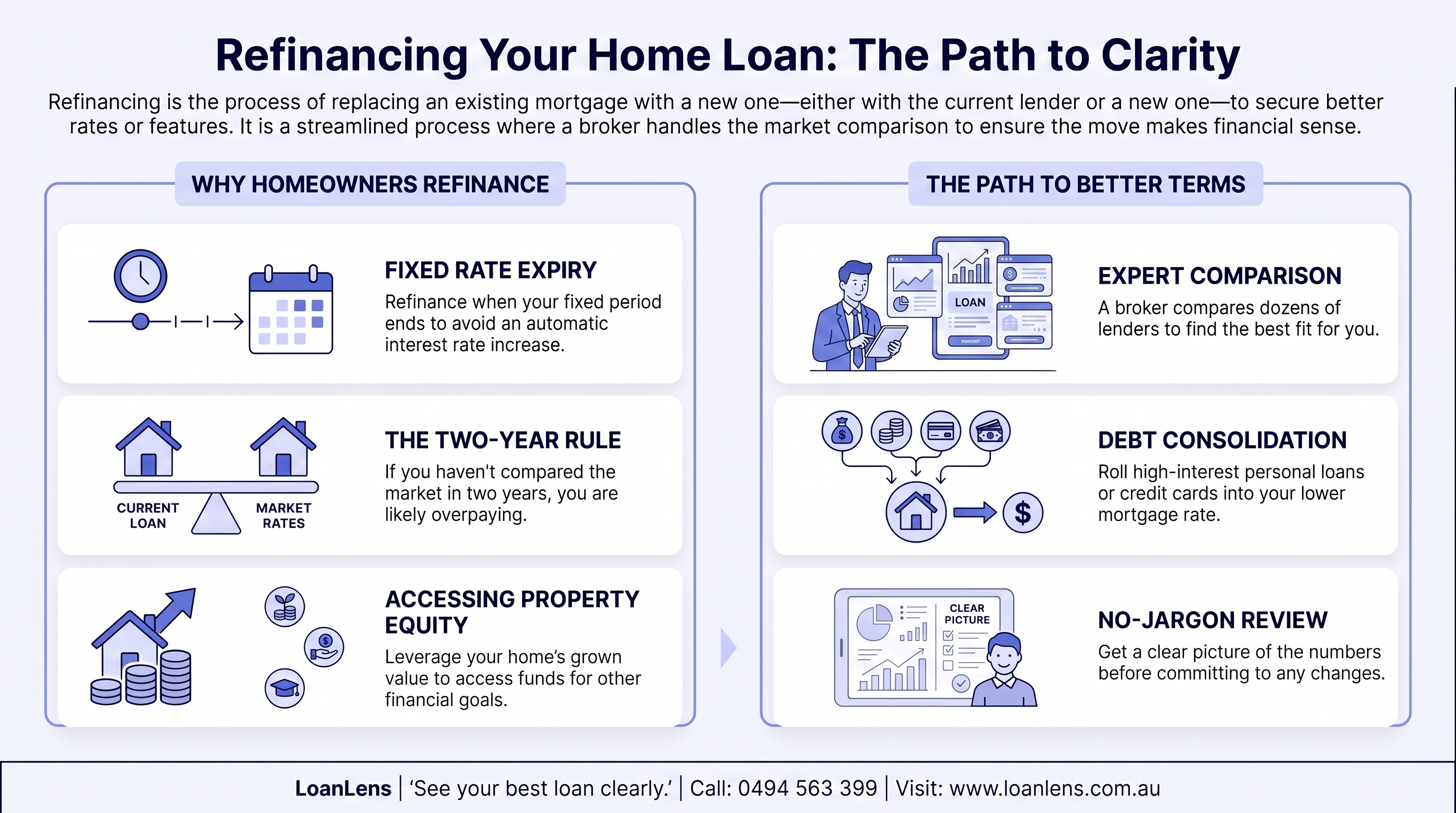
Every year, thousands of Australian homeowners pay more than they need to on their mortgage. Not because they cannot get a better deal, but because the word refinancing sounds technical and no one has explained it clearly. Once you understand the basic mechanics, the question shifts from "what is it" to something far more useful: "does it make sense for me right now, and what would it actually cost and save?"
This guide answers both.
The Simple Answer: What Refinancing Actually Is
Refinancing your home loan means replacing your current mortgage with a new one. The new loan is generally for a similar amount to your remaining balance, though some homeowners refinance for a larger amount to access equity they have built up in the property. The incoming lender pays out your existing loan, registers their security interest over your property, and you begin making repayments on the new loan.
That is the whole concept. You are not buying a new property. You are not taking on a second mortgage. You are swapping one loan for another, ideally on better terms.
In technical terms: the bank you leave is called the outgoing lender and your old mortgage is discharged. The bank or lender you move to is the incoming lender. A mortgage broker manages most of this process on your behalf.
Why Australian Homeowners Choose to Refinance
To Secure a Lower Interest Rate
This is the most common reason. Lenders frequently offer sharper rates to new customers than they extend to existing ones. A loan that was competitive two or three years ago may sit well above the current market for a borrower with your profile and equity level. Even a modest rate reduction on a $700,000 balance translates into thousands of dollars saved annually, and over a 25 or 30 year term that compounds considerably. A mortgage broker can model this comparison clearly in a single appointment using your actual figures.
To Access Equity Built Up in the Property
Equity is the difference between what your property is worth today and what you still owe on your mortgage. If your home has grown in value since you purchased it, you may have built up substantial equity without making any additional repayments. Refinancing can unlock a portion of that equity as accessible funds, which homeowners commonly direct toward renovations, a deposit on an investment property, or other significant financial goals. This approach is sometimes called a cash out refinance or equity release.
To Change Loan Features
Home loans are not all built the same. Some products include offset accounts that reduce your daily interest charge. Some have redraw facilities. Some allow additional repayments without penalty and others restrict this. If your current loan is missing a feature that would genuinely benefit your situation, refinancing to a product that includes it can be worthwhile even when the interest rate difference is modest.
To Consolidate Other Debts
Some homeowners refinance to roll higher-interest obligations, such as personal loans or credit card balances, into their mortgage. Because home loan rates are generally lower than unsecured debt rates, this can reduce monthly repayments and simplify finances into a single payment. The trade-off is real though: you are spreading that debt over a longer term, which changes the total interest cost even at a lower rate. Understanding both scenarios before proceeding matters, and a good broker will walk you through both clearly before recommending anything.
To Switch Between Fixed and Variable
Fixed rate loans lock in your interest rate for a defined period, typically one to five years. Variable rate loans move with market conditions. Refinancing lets you shift from one to the other, or structure a split loan that combines elements of both. Many homeowners refinance specifically at the end of a fixed rate period to avoid rolling onto a higher standard variable rate with their current lender.
How the Home Loan Refinancing Process Works
The process is more accessible than most homeowners expect. Here is how it typically unfolds.
Step 1 - Review Your Current Loan
The starting point is understanding exactly what you are on right now. What is your current rate? Is it fixed or variable? When does the fixed term expire? Are there discharge fees or break costs for leaving early? Your broker will compile this information and establish your starting position before any comparison work begins.
Step 2 - Clarify What You Want to Achieve
Are you purely after a lower rate? Do you want to access equity? Are you looking to change your loan term or restructure repayments? Defining your goals before comparing products means the search is focused on loans that actually solve your problem rather than ones that simply look appealing in a comparison table.
Step 3 - Compare the Market
Your broker compares products across a panel of lenders. This typically includes the major banks, regional banks, mutual lenders, and non-bank lenders. Rate, fees, comparison rate, loan features, and each lender's credit policy as it applies to your situation are all assessed together. This step alone is where most of the broker's value is delivered, because the market is wide and lender credit policies vary considerably.
Step 4 - Apply and Provide Documentation
Once you have selected a loan, a formal application is submitted. The incoming lender requires documentation covering income, assets, liabilities, and the property's current value. An independent valuation is usually ordered by the lender at this stage. Your broker manages the process and handles communication with the lender throughout.
Step 5 - Settlement and Discharge
When the loan is approved and settles, the incoming lender pays out your old loan. The outgoing lender discharges the mortgage and removes their security interest from your property. The new lender registers their interest. From application to settlement, the full process typically takes two to six weeks depending on the lenders involved and how quickly documentation is provided.
The Real Costs Involved and How to Assess Them
Refinancing is not free, and the costs involved need to be weighed carefully against the potential savings before proceeding. Common costs include:
Discharge fees from your outgoing lender. These cover the administrative process of closing your old loan and vary by lender.
Break costs if you are exiting a fixed rate loan before the term ends. These can be substantial depending on how far through the fixed period you are and how market rates have moved since you fixed. Always check this figure first.
Application or establishment fees from the incoming lender. Some lenders waive these for refinancers. Others do not.
Lenders Mortgage Insurance. If your loan to value ratio exceeds 80%, the incoming lender may require LMI. This is an insurance premium that protects the lender, not you, and can represent a significant cost. Refinancing near an LVR band boundary requires careful calculation because capitalising LMI into the loan can push your actual LVR into a higher premium band.
Valuation fees. The incoming lender will typically order an independent property valuation. Some lenders absorb this cost, others pass it on.
Your broker will calculate a break even point. If the monthly savings from the new rate recover the total cost of switching within a reasonable period, typically 12 to 24 months, refinancing generally makes financial sense. This calculation is fundamental to any good mortgage broker's recommendation process.
A Real-World Scenario
Consider a homeowner in Melbourne who took out a home loan four years ago. At the time the rate was competitive. Since then, they have made consistent repayments, the property has grown in value, and their financial position has strengthened.
A mortgage broker reviews the loan and finds the current rate sits above the market for a borrower with this equity level and credit profile. After accounting for discharge fees and the incoming lender's setup costs, the broker calculates that refinancing reduces the monthly repayment meaningfully, with the full cost of switching recovered in under 18 months.
The homeowner proceeds. The broker manages all documentation and lender communication. The new loan settles within four weeks. The homeowner moves onto a more competitive rate with the offset account feature they had been wanting.
This type of outcome is not unusual. It is the kind of review LoanLens conducts every week.
Common Mistakes to Avoid When Refinancing
Comparing only the headline interest rate and ignoring the comparison rate. The comparison rate includes most standard fees and charges and gives a truer picture of the total annual cost of the loan.
Not checking break costs before starting the process. For homeowners still inside a fixed rate period, break costs can be large enough to make refinancing financially counterproductive until the fixed term ends.
Refinancing too frequently. Each application generates a credit enquiry. Multiple enquiries in a short window can affect your credit score and make subsequent applications more complicated. Timing and planning matter.
Accessing equity without a clear financial purpose. Unlocking equity is a legitimate and often well-used strategy, but without a defined use and a plan for the increased repayments, it can raise your debt level without a corresponding benefit.
General information only. This article does not take your personal circumstances into account and does not constitute credit advice.