
First Home Buyers7 min read
Do First Home Buyers Really Need a 20% Deposit?
A 20% deposit isn't mandatory to buy your first home. Explore low-deposit pathways, LMI trade-offs and upfront costs for eligible first home buyers in Melbourne and across Australia.
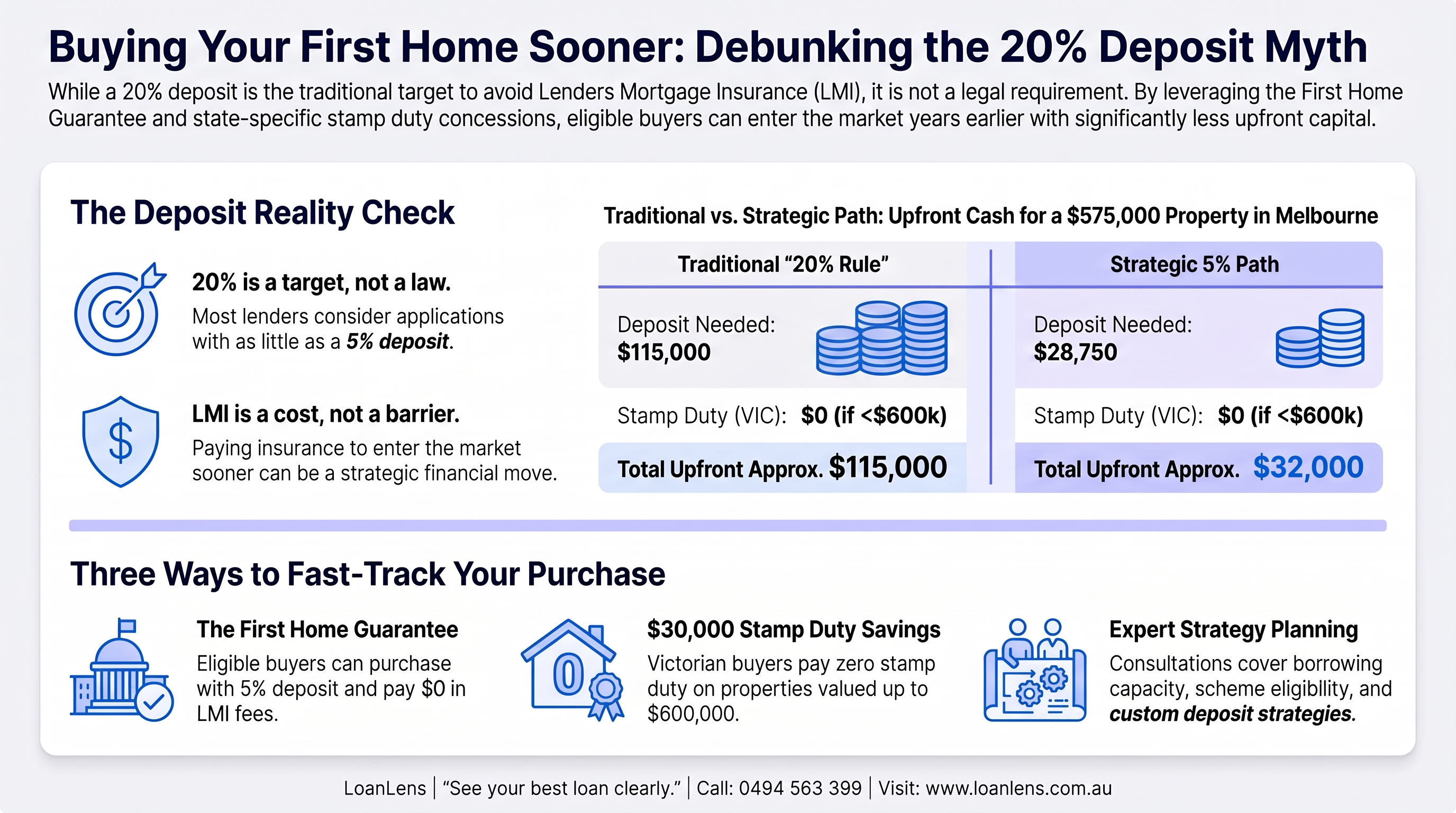
The idea that a 20% deposit is mandatory before applying for a home loan is one of the most widely repeated — and most costly — beliefs in Australian property. For many first home buyers, this single assumption adds years to their timeline, tens of thousands in additional rent paid, and in some markets, a property target that moves further away the longer the wait continues.
The truth is both simpler and more encouraging: a 20% deposit has never been a legal requirement. It's a cost-avoidance strategy. And in 2025, there are several clear, government-supported pathways that allow eligible buyers to enter the property market with significantly less — and in some cases, avoid the associated costs entirely.
This guide explains where the 20% rule came from, what the real deposit floor is, the four main low-deposit pathways available to Australian first home buyers, and how to work out which route suits a specific situation.
Where the 20% Deposit Rule Came From
The rule has a logical origin. When a borrower takes out a home loan with a deposit less than 20% of the property's value, the Loan-to-Value Ratio (LVR) exceeds 80%. At that point, most lenders require the borrower to pay Lenders Mortgage Insurance — an insurance product that protects the lender (not the borrower) in the event of default.
LMI can be expensive. On a $600,000 property at 95% LVR, LMI premiums can range from approximately $20,000 to $28,000 depending on the lender and mortgage insurer. The conventional advice — save to 20% and avoid it — made sense when there were no alternatives.
There are now alternatives. Multiple of them.
What the Real Deposit Floor Looks Like for First Home Buyers
Most Australian lenders will consider home loan applications with a deposit as low as 5% of the purchase price, provided the borrower can demonstrate genuine savings (funds held in a savings account, typically for a minimum of three months), stable income, and satisfactory credit history.
Key term: Loan-to-Value Ratio (LVR)
LVR is the proportion of a property's value being borrowed. A buyer purchasing a $550,000 property with a $27,500 deposit (5%) has an LVR of 95%. LMI applies at any LVR above 80%, with premiums increasing at higher LVRs.
Two points worth understanding:
LMI can often be capitalised into the loan, meaning it doesn't require additional cash at settlement
Buying at 95% LVR is not the same as buying recklessly — many buyers do so with full awareness of the trade-offs and a clear plan to build equity over time
Four Pathways to Buying Your First Home with Less Than 20%
There isn't one way to enter the property market below the 20% threshold. There are four clearly defined options, each suited to a different financial situation.
Option 1 — 5% Deposit with Lenders Mortgage Insurance
The most straightforward path. Apply with a 5% deposit, accept the LMI cost, and enter the market. This option is available through most major and non-major lenders without scheme eligibility requirements.
When this makes sense: When scheme eligibility isn't available (e.g., income above the First Home Guarantee threshold), or when speed to market outweighs the cost of LMI.
Illustrative example: A buyer purchasing a $580,000 property in Melbourne with a $29,000 deposit (5%) accepts an LMI premium of approximately $18,000 to $22,000, capitalised into the loan. Total upfront cash needed: approximately $29,000, plus conveyancing and inspection costs.
These figures are illustrative. Actual LMI costs vary by lender and insurer.
Option 2 — 5% Deposit via the First Home Guarantee (No LMI)
The Australian Government's First Home Guarantee, administered by Housing Australia, allows eligible first home buyers to purchase with a 5% deposit and pay no LMI. The federal government acts as guarantor for the difference between the buyer's deposit and the 80% LVR threshold. There is no cost to the buyer for the guarantee.
Eligibility at a glance:
Individual income: $125,000 or below per year
Joint income: $200,000 or below combined
Must not have previously owned property in Australia as an owner-occupier
Property must be owner-occupied (not investment)
Property price caps apply by state — in Victoria, the cap is $800,000 for Melbourne and major regional centres
A limited number of places are available each financial year. For 2024–25, 35,000 places were made available across the scheme and related guarantees. Applications go through accredited lenders only.
Eligibility criteria, income thresholds, and property price caps are subject to change. Verify current details via Housing Australia's official website or through an accredited mortgage broker.
Option 3 — Guarantor Home Loan (Potentially Zero Cash Deposit Required)
A guarantor loan allows a family member — typically a parent or immediate relative with equity in their own property — to use that equity as security for a portion of the buyer's loan. This can reduce or eliminate the need for a cash deposit from the buyer.
How it works in practice: the lender takes security over both the buyer's new property and a portion of the guarantor's property. The guarantor's liability is typically limited to the shortfall between the buyer's deposit and the 80% LVR benchmark (a "limited guarantee" rather than the full loan amount). Once the buyer builds sufficient equity through repayments and property value growth, the guarantee can be released, removing the guarantor's exposure.
Important considerations: This arrangement carries real risk for the guarantor. If the buyer defaults, the lender can pursue the guarantor's property. Independent legal and financial advice for the guarantor is standard practice and often required by the lender.
Option 4 — Regional First Home Buyer Guarantee
For buyers purchasing in eligible regional areas of Australia, the Regional First Home Buyer Guarantee offers the same structure as the standard First Home Guarantee — 5% deposit, no LMI — but with a focus on regional property markets. This scheme was introduced in recognition of the different supply and demand dynamics in regional areas. Eligibility criteria and property price caps differ from the main First Home Guarantee. Buyers in [City/Suburb] regional areas should verify current caps through Housing Australia.
The LMI Trade-Off — Paying It vs. Waiting to Avoid It
LMI gets a bad reputation, but it's worth running the actual numbers before deciding it's something to avoid at all costs.
Consider a buyer currently paying $2,200 per month in rent, with an LMI cost of $20,000 at 5% deposit on their target property.
Saving an additional $80,000 (to reach 20%) at $1,200 per month takes approximately 5.5 years
Rent over that same period: approximately $145,000
Total "cost to avoid LMI": $145,000 in rent, plus five years of potentially missed capital growth
The LMI premium of $20,000 often costs less than 6 months of rent, paid once, and enables market entry years earlier.
That calculation doesn't always tip in favour of buying early — it depends on income stability, market conditions, and personal circumstances. But it's a calculation worth actually doing, rather than assuming the answer.
What to Budget Beyond the Deposit
A 5% deposit covers the deposit requirement. It doesn't cover everything. First home buyers should budget separately for:
Conveyancing fees: approximately $1,200–$2,500
Building and pest inspection: approximately $400–$800
Loan establishment or application fees: varies by lender, from $0 to approximately $800
Moving costs: variable
Lender's valuation fee: sometimes charged separately
Victorian first home buyers also have access to significant upfront savings:
Stamp duty exemption on properties up to $600,000 (saving up to approximately $31,000)
Concessional stamp duty on properties between $600,001 and $750,000
First Home Owner Grant of $10,000 for eligible new or substantially renovated properties under $750,000
In Melbourne and across Victoria, these combined benefits can reduce the total upfront cost of a first home purchase considerably from what most buyers initially expect.
Your Next Move — A Simple Three-Step Framework
Step 1: Know your actual borrowing capacity
Before making assumptions about what's affordable, get a realistic assessment based on current income, expenses, and credit history.
Step 2: Check scheme eligibility
Income, property type, and purchase intent all affect which schemes apply. This is worth checking with an accredited broker before spending significant time on a strategy that assumes eligibility.
Step 3: Compare pathways, not just deposit amounts
The right deposit strategy isn't always the lowest number. Compare the total cost of each pathway - including LMI, interest over time, and opportunity cost - against the buyer's specific timeline and financial position.
LoanLens offers a free 30-minute first home buyer consultation - no obligation, no sales pressure, and no assumptions about what a buyer can or can't afford. Founder Piyush Singh has 15 years of lending and credit experience and works with first home buyers across Melbourne and Australia to map out a clear, realistic path to purchase.
📅 Book a free 30-minute call: https://calendly.com/piyush-singh-loanlens/30min
📋 Follow to stay updated: https://tinyurl.com/LoanLens
🌐 Visit: www.loanlens.com.au
LoanLens Financial Pty Ltd (trading as LoanLens) is a Credit Representative of Purple Circle Financial Services Pty Ltd. This content is general in nature and does not constitute personal financial or credit advice. Government scheme eligibility criteria, income thresholds, property price caps, and annual place allocations are subject to change. Seek independent professional advice before acting.
General information only. This article does not take your personal circumstances into account and does not constitute credit advice.